
Hierarchies, silo thinking, and short-term pressure to act – why classic police organizations must rethink strategically. And a concrete proposal on how this can succeed.

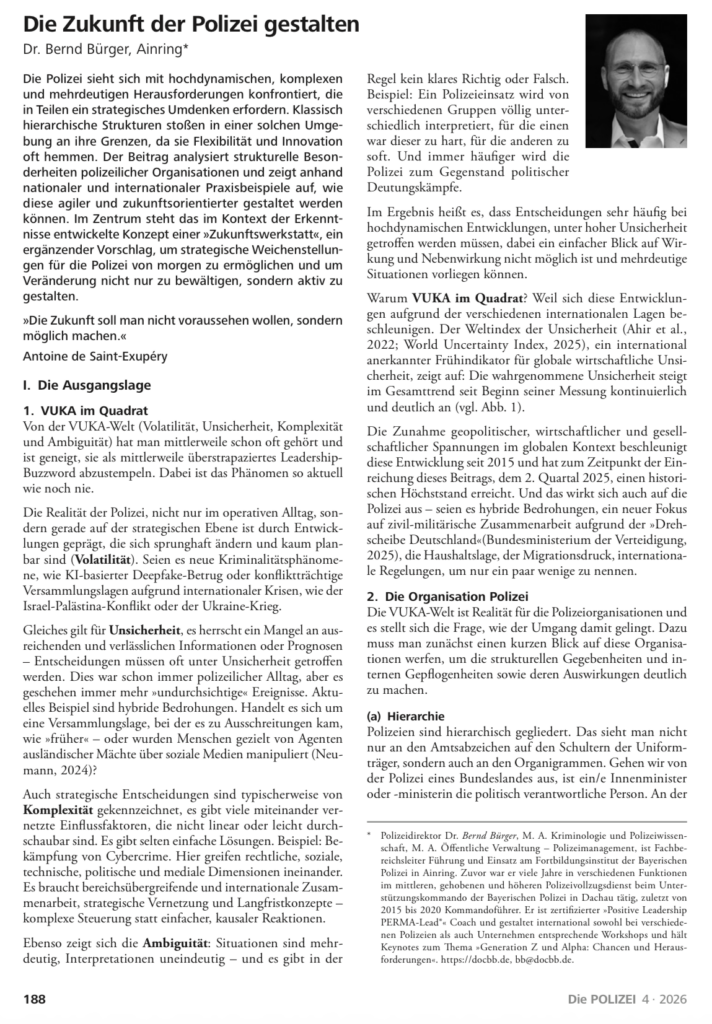
First publication: POLIZEI, Issue 4/2026, pp. 188–192 (Carl Heymanns Verlag)
The world is VUCA – we all know that. Volatility, Uncertainty, Complexity, Ambiguity. By now, it almost sounds like a tired buzzword. Yet, the phenomenon is more relevant than ever – and this is particularly true for police organizations.
My article in the current issue of The POLICE takes this point very seriously. I call it VUCA squared: The described dynamics are accelerating, and the world uncertainty index has reached an all-time high at the time of writing. This impacts hybrid threats, civil-military cooperation, the budget situation, and migration pressure – in short, everything that currently makes strategic leadership in policing difficult.
The structural problem
Police organizations are hierarchical, large, and highly specialized. There are good reasons for this. Hierarchy creates stability, clear responsibilities, and reliable action even under pressure. And: the police can handle (almost) any operation. That is their DNA.
But precisely this structure makes strategic thinking difficult. When information is filtered through many levels, when silos compete instead of cooperating, when every acute incident ties up resources – then there is little room left for long-term thinking. This is not a failure of individuals. It is a structural problem.
„Don't try to predict the future, try to make it happen.“ - Antoine de Saint-Exupéry
What already works – and where the limits lie
The article looks at concrete approaches, nationally and internationally. In Great Britain, there is Police Foundation an independent think tank that regularly publishes on future topics. The National Police Chiefs‘ Council has developed a „Policing Vision 2030.".
In Germany, there are also interesting approaches: the topic sponsorships of the Bavarian police headquarters, the Strategy Department in Lower Saxony using OKRs as a management method, and the House of Police in Hesse with five functional pillars.
What unites all these models: They attempt to establish a dual organizational form – hierarchy for stability and day-to-day business, agile elements for adaptation and innovation. This is the right approach. The weakness usually lies in the implementation: Those who work in both part-time and full-time roles can hardly dedicate themselves to both. And agile structures that are overgrown by bureaucratic mindsets eventually become just another working group.
The Future Workshop – A Model Concept
From this, I developed my own model: the »Future Workshop«. It consists of three work areas.
- Ideas workshop: Permanent Team for Future Foresight, Networking, Innovation Management, and Strategic Consulting for Agency Leadership
- Future Workshop Agile, project-based team without permanent employees – full-time commitment, iterative cycles, short decision-making processes
- Perspective Editorial Board: Internal communication that not only explains change but truly brings employees along
The key difference from traditional working groups: Participation in the future workshop is the Main task. Not an add-on to the day-to-day business. That sounds simple, but it isn't – it means a conscious decision by the organization to truly prioritize strategic work.
Specifically, the team works in iterations of a maximum of two weeks, escalates decisions directly to a „topic sponsor“ at the agency leadership level, and can continue to work continuously. This allows for short decision-making loops instead of long stakeholder cascades.
Three topics that would be worthwhile
Our Talents. In every large police organization, there are people with special skills—agile methods, multilingualism, coaching competencies. Hardly any organization can systematically tap into this treasure. No database, no process, no structure.
Our careers. Generalist training has its justification – but is it sensible for all roles? Does an IT investigator need the same basic physical constitution as a patrol officer on night duty? Modular career paths would be an obvious next step, and some police forces are already taking them.
Our communication. If, in an organization with 35,000 employees, each person spends just three minutes daily sifting through emails not explicitly addressed to them, it adds up to almost one full-time employee. Communication culture is not a soft issue. It's an efficiency issue.
Conclusion
The police can handle VUCA – they demonstrate it every day in their operations. They get ahead of the situation. They work with mission tactics. They trust the people on the street.
Strategically, nothing else is needed. A kind of steering committee that supports decision-makers in setting the right course for the future. The expertise is there. The structure is still missing.
Together.Future.Shape.
The full article can be found in The POLICE, Issue 4/2026, published by Carl Heymanns Verlag.