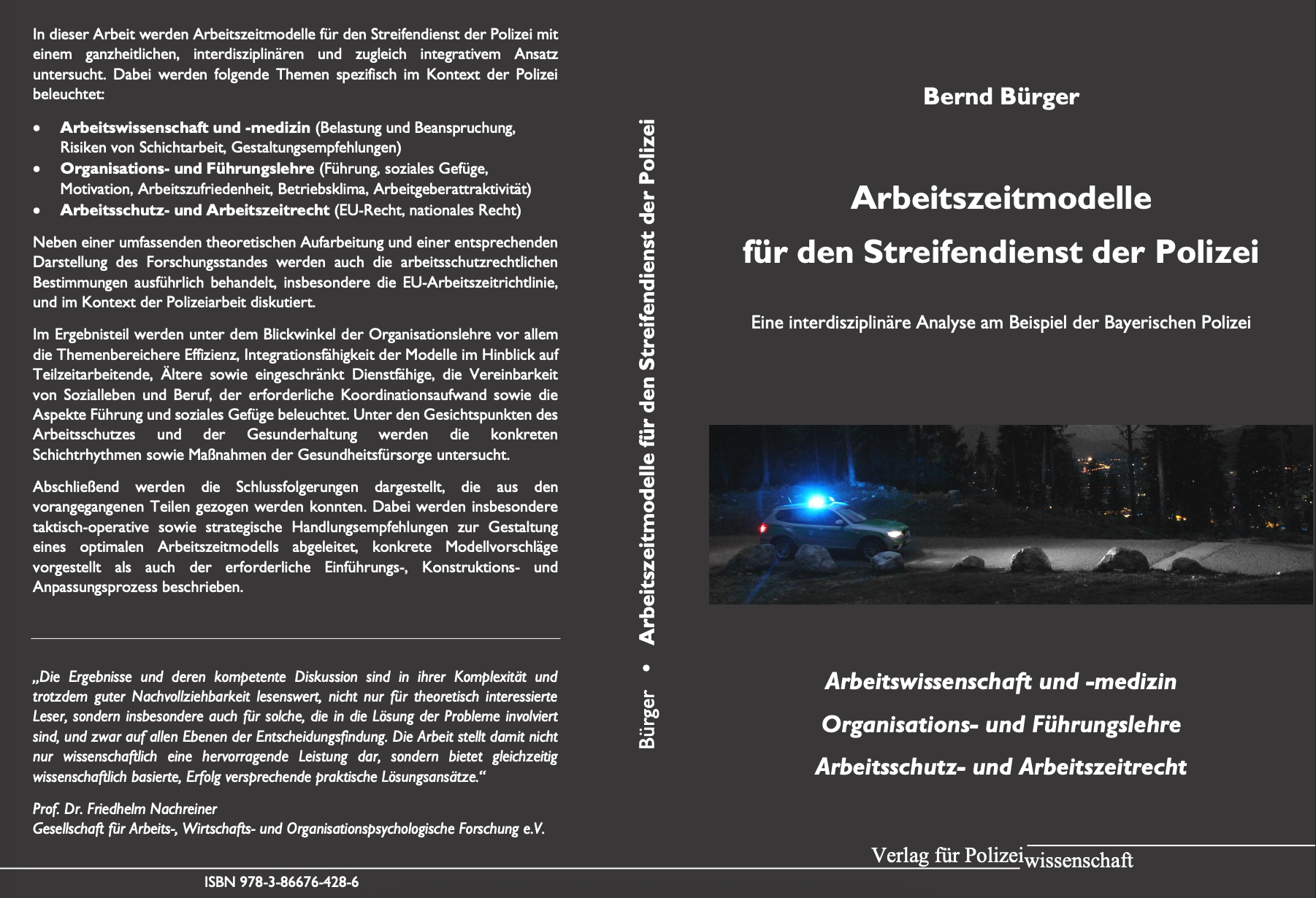
Mein Buch zu den Arbeitszeitmodellen jetzt kostenlos. Wer im Streifendienst arbeitet, weiß: Der Dienstplan bestimmt den Takt des Lebens. Seit Jahren beschäftige ich mich intensiv mit der Frage, wie wir diesen Takt besser, gesünder und verträglicher gestalten können und habe dazu 2015 meine Dissertation verfasst.. Meine Dissertation "Arbeitszeitmodelle für den Streifendienst der Polizei" war lange Zeit über … Weiterlesen
Endlich ist er erschienen, der Artikel von Dr. Anna Arlinghaus und mir. Und das Beste: man kann ihn kostenlos lesen. Und Dank der freundlichen Genehmigung durch die Schriftleitung von „Die POLIZEI“, Prof. Dr. jur. Dieter Müller, darf ich Euch auch noch einen Artikel aus 2018 von Verwaltungsrichterin Cornelia Alberts und mir zum Download anbieten: "Die … Weiterlesen
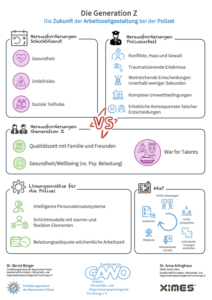
Ist der Schichtdienst bei den Polizeien, so wie er aktuell gestaltet ist, noch zukunftsfähig? Der jungen Generation sind freie Wochenenden (84,9 Prozent) und keine Schichtarbeit (60,2 Prozent) wichtig.1 Dabei ist Polizeiarbeit zweifelsohne eine 24/7 Dienstleistung: "Wir stehen ein für die Sicherheit der Menschen und leisten Hilfe rund um die Uhr"2 Doch wie lässt sich das … Weiterlesen
Full version - shortened article published by the German Society for Time Policy, Zeitpolitisches Magazin No. 36 July 2020 (ISSN 2196-0356, download here).
"We stand up for people's safety and provide help around the clock."1Bavarian State Ministry of the Interior, Leitbild der Bayer. Polizei - Handlungs- und Orientierungsrahmen für die Zukunft, https://www.polizei.bayern.de/wir/leitbild/index.html/3249, accessed on 01.03.2020
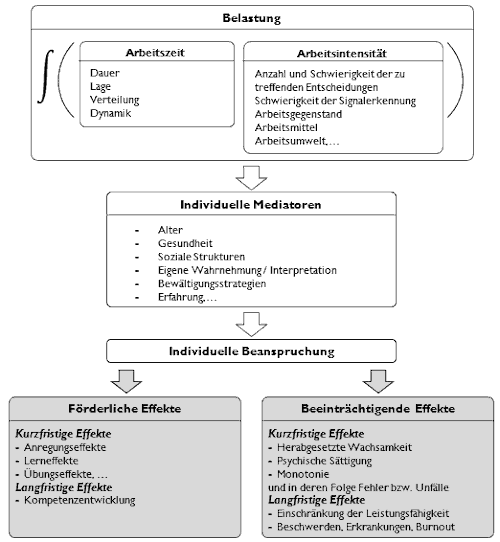
This quote from the mission statement of the Bavarian Police undoubtedly applies to all police authorities - they guarantee security in a society around the clock. Although the work is 24/7224/7 stands for 24 hours, 7 days a week, i.e. the provision of work every day at any time. This is not a unique feature of police work, as around one in six employees in Germany works shifts (Radtke 2020), but it is characteristic of police work. In order to understand the (time) organization of police work and its impact on public safety, it is also necessary to understand the effects that shift work, which is necessary to ensure the constant availability of the police, has on people. Even if some police working time organizers do not seem to take this into account, police officers are also human beings and the organization of shift work has a significant influence on their ability to perform and act and thus directly on (in)security in public spaces.
Since my dissertation, I've been fascinated by working time law. That's why I want to stay on the ball in this area too and have familiarized myself with a recent ruling by the OVG Münster from 13.02.2020 (1 A 1512/18) has dealt with. However, if you have done a lot of research into working time law, you will find that there are no major surprises in this ruling when it comes to rest periods and working time. Nevertheless, I would like to pick up on this ruling and outline a few key points, as my previous publications on working time have been published in specialist journals that are not so easily accessible or divisible. In addition, there still seems to be a lack of clarity regarding the terminology, otherwise this ruling would not exist 😉 .